
Blood Flow Restriction Therapy
Build real strength on tissue that can't yet handle a heavy load — without the heavy load.
Get real strength gains from a fraction of the load, using Blood Flow Restriction Therapy
Blood Flow Restriction (BFR) therapy uses a pneumatic cuff to partially restrict blood flow to a limb during light exercise — letting a muscle do meaningful strength work at a fraction of the load it would otherwise need. At ChiroMovement, we use it to bridge the gap for tissue that’s too irritated, too early post-surgery, or too deconditioned to tolerate full-load training, so early rehab still builds capacity instead of just maintaining it.
When the load your rehab needs is more than your tissue can currently take
This shows up constantly in early rehab: the tissue needs a real strength stimulus to change, but it’s fresh out of surgery, inflamed, or too deconditioned to safely handle the weight that would normally produce that stimulus. A resistance band alone often isn’t enough load to matter. Jumping straight to heavier weight risks setting the tissue back.
That gap — needing more stimulus than the tissue can currently tolerate — is exactly the problem BFR was built to solve.
"Many rehab programs lean on a theraband to add mild load to a joint or muscle, but a band alone often can't provide enough stimulus to actually drive change. That's where blood flow restriction shines — it lets us create a real training effect at a fraction of the load."
Dr. Steven Bird, on why BFR fills a gap standard rehab tools can'tWhat is Blood Flow Restriction therapy?
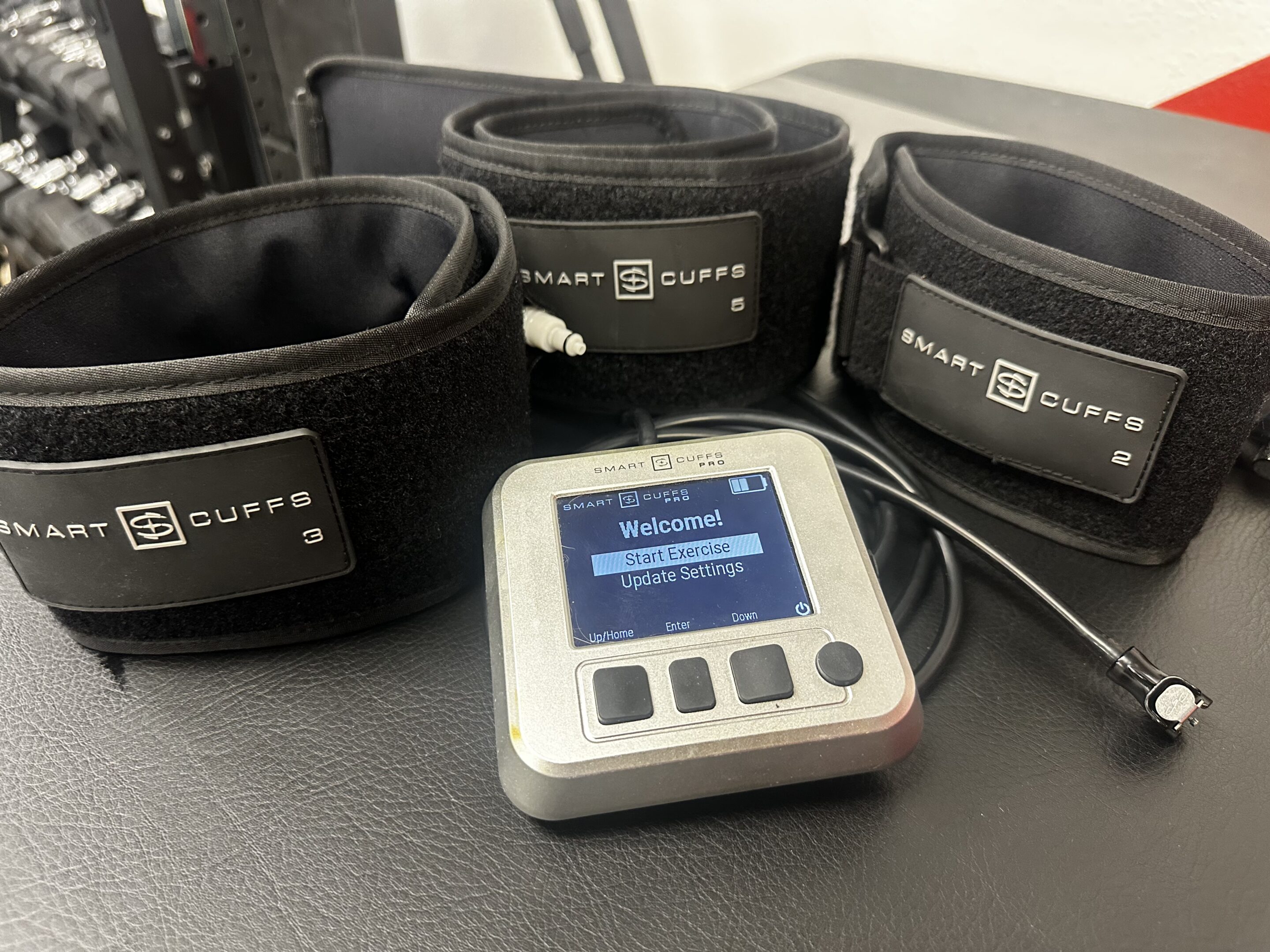
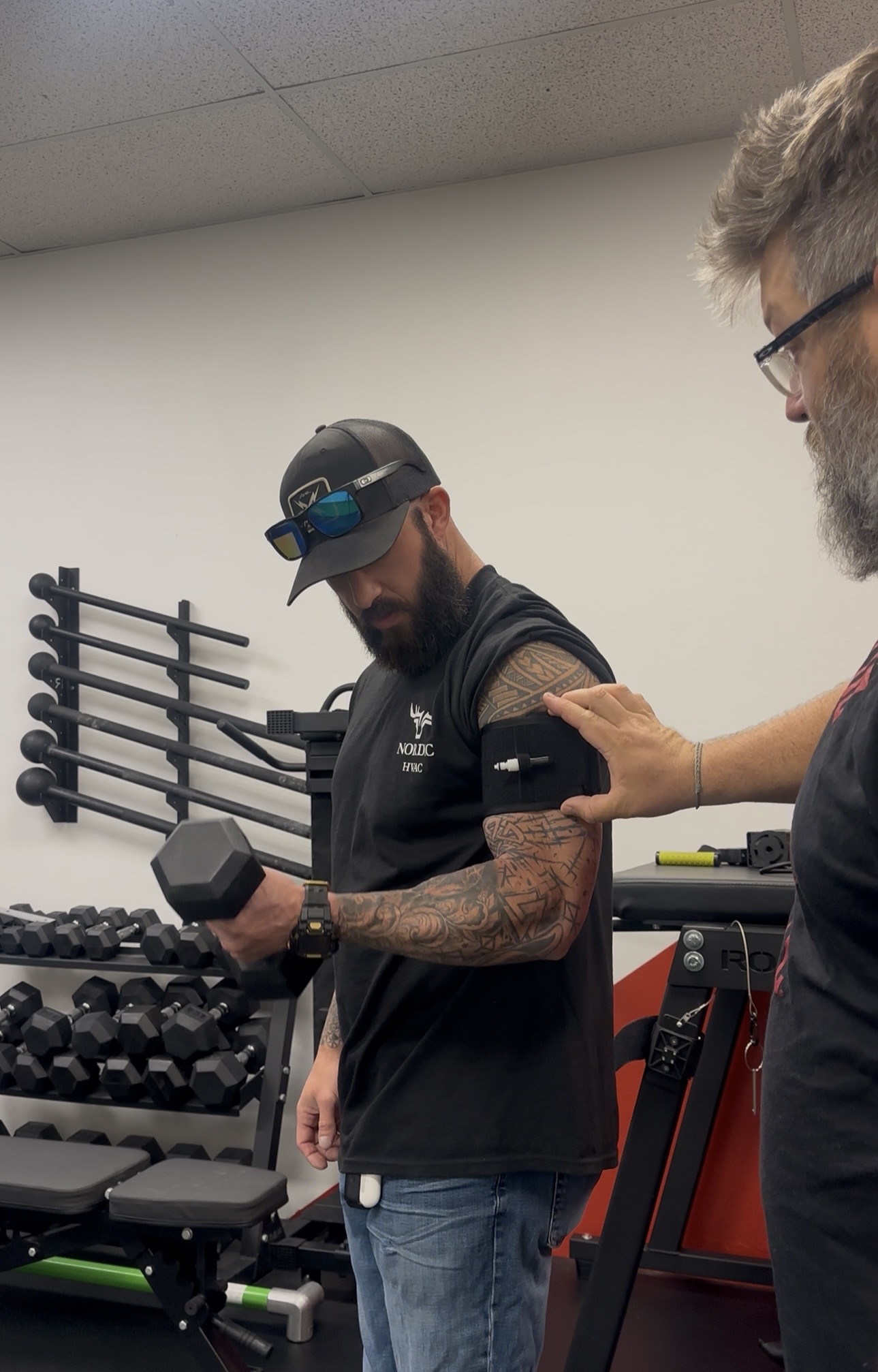
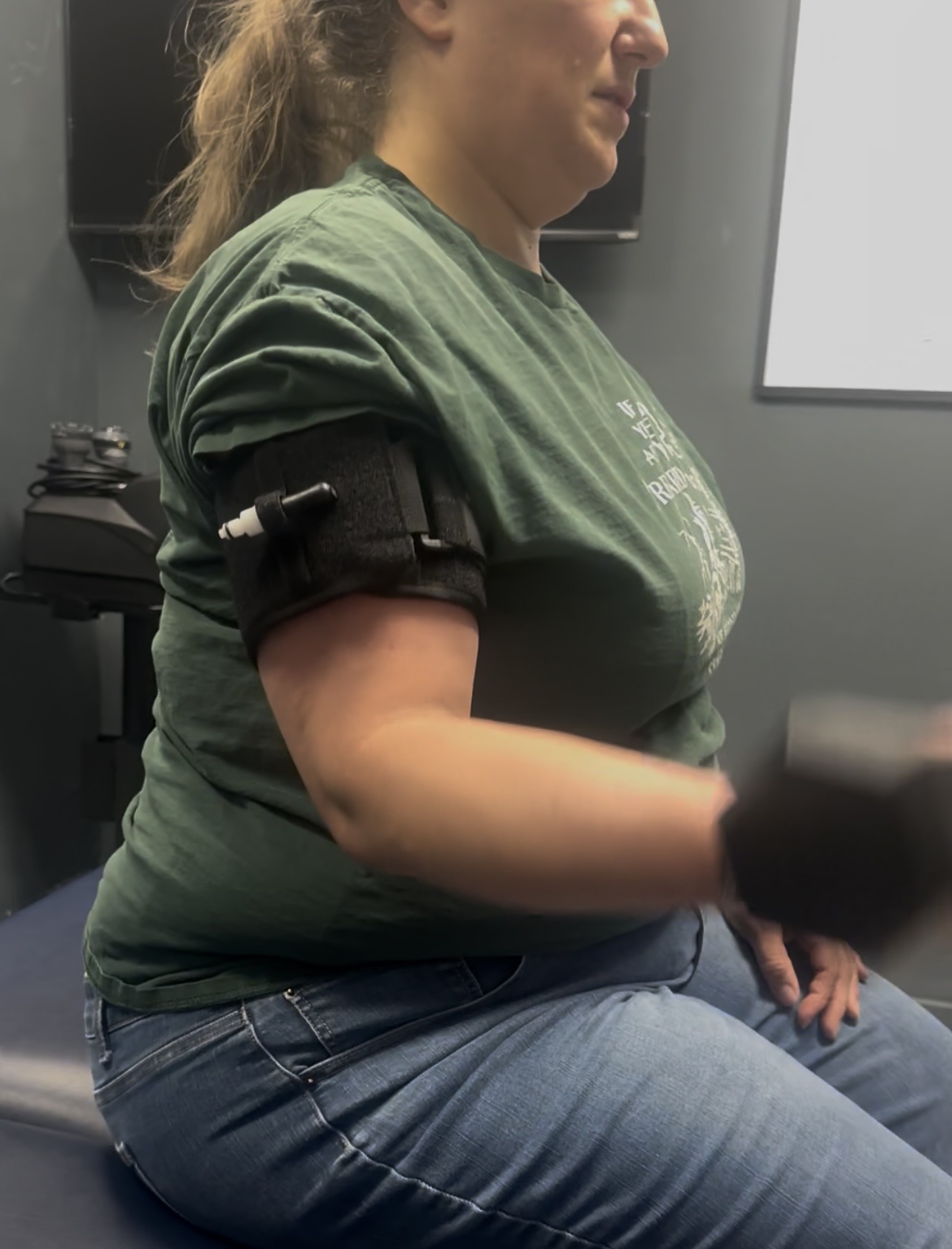
BFR uses an elastic band or pneumatic cuff placed around the upper portion of a limb to partially restrict — not fully block — arterial and venous blood flow while you exercise. With less oxygen reaching the working muscle, the body accumulates metabolic byproducts like lactate far faster than it normally would, even under a light load. That metabolic stress is a major driver of muscle growth and strength.
The technique isn’t new — it dates to 1960s Japan, where it was developed as KAATSU training (“additional pressure”). Since then it’s been adopted widely in sports medicine, the military, and post-surgical rehab, and the research base behind it has grown accordingly.
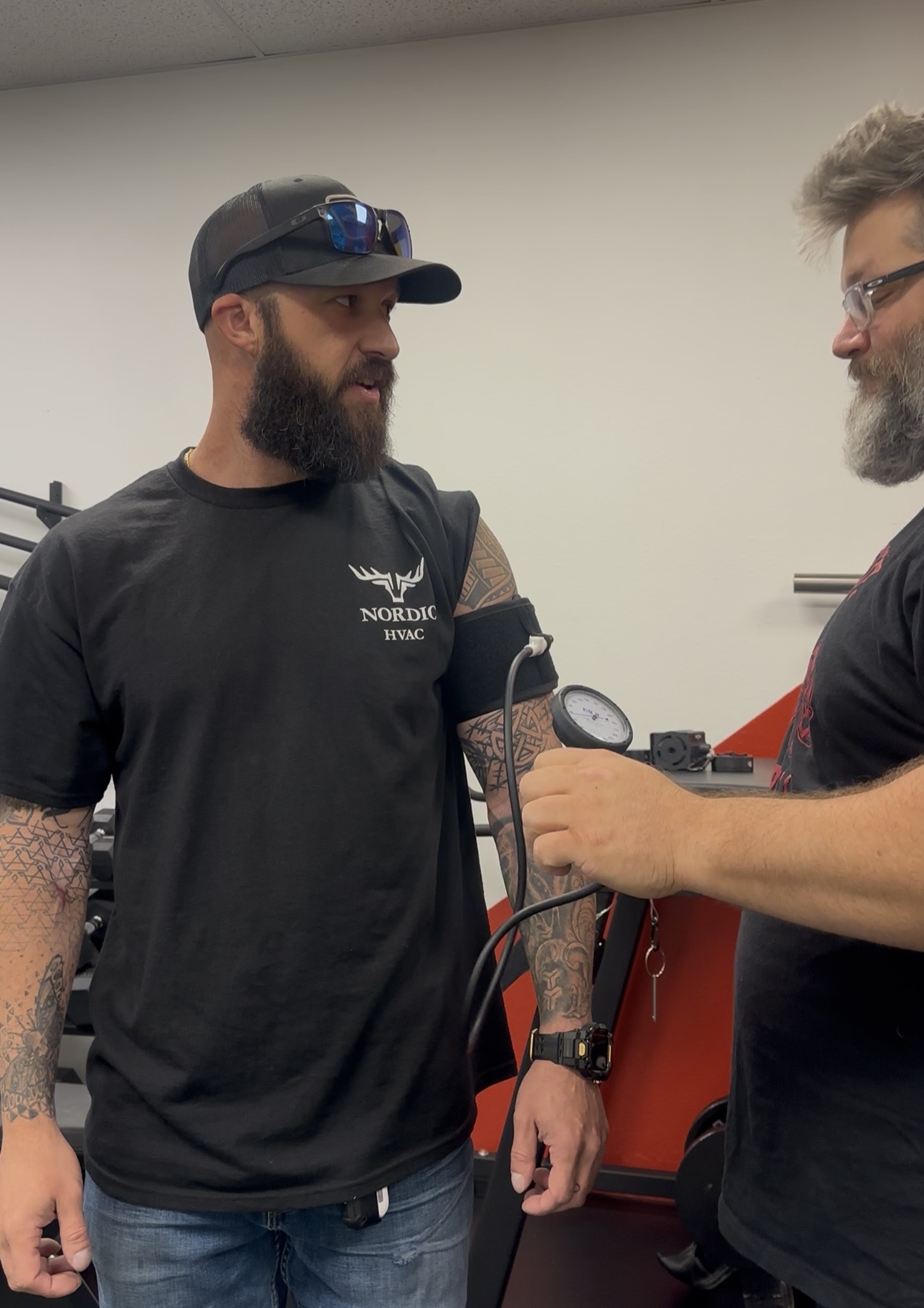
Cuff pressure is set as a percentage of your own limb occlusion pressure (LOP) — a measured value specific to your limb, not a fixed setting — and typically held for the duration of a set of low-intensity exercise, such as light dumbbell work, bands, or bodyweight movement.
Not a generic BFR band
The elastic bands sold online apply a fixed pressure to everyone, regardless of limb size or blood pressure — which means they're either doing too little or applying more restriction than is actually safe. We measure your limb occlusion pressure and dose the cuff to a percentage of that number, specific to you, every session.
Conditions we may treat with BFR therapy
Training & performance
- Returning to lifting after an injury, without the load
- Bridging a forced deload or taper block
- Maintaining muscle during a training break
- In-season load management around a flare-up
Everyday & degenerative
- Knee & hip osteoarthritis
- Age-related muscle loss (sarcopenia)
- General deconditioning
- Chronic joint pain that can't tolerate heavy load
Post-injury & recovery
- Post-surgical rehab (ACL, rotator cuff, joint replacement)*
- Early-stage muscle strains & sprains
- Immobilization-related muscle loss
- Tendon injuries needing load without irritation
*Post-surgical care coordinated with your surgeon's clearance.
Why hasn't standard rehab been enough?
Early rehab often gets stuck between two bad options: load that’s too light to build real strength, or load that’s too heavy for tissue that’s still healing. Muscle only grows and strengthens in response to real mechanical or metabolic stress — and a resistance band alone frequently can’t provide enough of either. BFR closes that gap by manufacturing metabolic stress directly, without needing the heavy load that would normally be required to produce it.
How Blood Flow Restriction therapy may help
The mechanism is metabolic — the muscle responding to an oxygen-limited environment, not the cuff doing the work for you.
Blood flow is partially restricted
The cuff is inflated to a percentage of your measured limb occlusion pressure — reduced blood flow to the muscle, not fully blocked.
Metabolic stress builds fast
With less oxygen reaching the muscle, lactate and other metabolic byproducts accumulate quickly, even under light load.
Fast-twitch fibers get recruited early
Type II muscle fibers — normally reserved for heavy lifting — get called in sooner because the muscle senses fatigue and low oxygen.
Anabolic signaling ramps up
Growth hormone, IGF-1, and muscle protein synthesis all rise in response, driving real strength and size gains despite the light load.
BFR is part of the plan — not the entire plan
BFR is rarely the whole visit. It’s layered into your broader rehab and strength training plan — used specifically for the window where your tissue can’t yet handle full load but still needs a real training stimulus. As your capacity builds, we reduce reliance on BFR and progress you onto standard loaded training, which is the real long-term goal.
What treatment looks like
We evaluate the problem
A real exam, not a five-minute look — we find out what's actually driving your pain or limiting your capacity.
We screen for whether BFR fits
Not every case is a BFR case. We screen for contraindications first and will tell you honestly if something else is the better first move.
We measure your occlusion pressure
Your cuff pressure is set to a percentage of your own measured limb occlusion pressure — not a generic fixed setting.
You train under restriction
Typically light-load exercise — a first set of around 30 reps, followed by a few shorter sets with brief rest between — or a longer low-intensity protocol for early post-surgical cases.
We reassess & progress
Strength, tolerance, and function — and we scale you off BFR and onto standard loaded training as soon as your tissue allows it.
Is this you?
- You're early post-surgery and can't yet load the area enough to build real strength back.
- You've got joint pain or arthritis that limits how much weight you can safely lift.
- You're dealing with age-related strength loss and want an effective way to rebuild it.
- You're an athlete working around an injury and need to maintain muscle without loading the area heavily.
Why ChiroMovement?

Measured, not guessed
Cuff pressure is set from your own measured occlusion pressure — not a one-size-fits-all elastic band.
One-on-one care
You see Dr. Bird, not a rotating tech — every visit, every dosing decision.
Built into a full plan
BFR is layered into your rehab and strength training, not sold as a stand-alone gadget session.
Built for active adults
From competitive strength athletes to anyone recovering from surgery or just rebuilding lost strength.
Honest screening
If BFR isn’t appropriate for your case — or isn’t the right tool yet — we’ll say so before we schedule it.
Care designed to help you move forward
Dr. Steven Bird is a chiropractor at ChiroMovement in West Jordan, Utah. His approach goes beyond an “adjust-and-go” model by combining individualized assessment, manual treatment, progressive rehabilitation, and technologies such as shockwave therapy when appropriate.
The purpose of care is not to chase perfect alignment or keep you dependent on treatment. It is to help you build the movement options, strength, and physical capacity needed to return to the life you want to live.

Reviews


Is this the same as the BFR bands sold online?
No. Those apply a fixed pressure regardless of your limb size or blood pressure. We measure your actual limb occlusion pressure and set your cuff to a specific, calculated percentage of it, every session.
Does BFR hurt?
Most patients feel pressure and a “pump” or burning sensation in the muscle during exercise — this is the intended metabolic effect, not tissue damage. The cuff is released between sets and immediately after.
Is BFR safe?
When properly screened and dosed by a trained provider, research supports BFR as a safe technique. That said, it isn’t appropriate for everyone — screening for contraindications is part of every evaluation.
Who shouldn’t do BFR?
It’s generally avoided with a history of blood clots, active cancer, pregnancy, impaired circulation, lymphedema, an open wound or fracture near the cuff site, or significantly elevated cardiovascular risk. We’ll screen for this at your evaluation.
How much weight will I be lifting?
Typically 20–30% of what you could normally lift for one rep — the restriction, not the weight, is what’s creating the training effect.
Do you take insurance for BFR therapy?
As this is considered as part of rehab yes it would be considered as a covered service within an insurance model.
You don't have to wait until you can lift heavy again.
Let’s find out if BFR fits your plan.
ChiroMovement · West Jordan, Utah
Blood Flow Restriction therapy outcomes vary by condition, tissue involved, and individual response. This page is educational and doesn’t replace an in-person evaluation — the exam and occlusion pressure measurement are what determine whether BFR is appropriate for your specific case.